
Acne can disappear and still leave a story behind. Some patients are left with brown, gray, red, or pink marks that linger long after a breakout. Others notice depressions, raised areas, or uneven skin texture that changes how light falls across the face. Although people often call all of these concerns acne scars, they aren’t medically the same thing.
According to the American Academy of Dermatology (AAD), true acne scars involve structural changes that develop as the skin heals after acne. Flat discoloration can instead represent post-inflammatory changes rather than permanent scarring. This distinction matters because an effective acne scar treatment should match the problem you’re actually seeing.
At Fitzy Shades MedSpa, options such as SkinPen microneedling, Morpheus8 RF microneedling, ablative laser resurfacing, chemical peels, and BioRePeel can play different roles in a skin-rejuvenation plan.
Keep reading to understand how to improve acne scars without treating every mark or textural change as though it needs the same procedure.
First, Know What Acne Left Behind
The type of scar matters because different acne scars respond differently to treatment. The AAD’s acne-scar treatment guidance specifically notes that successful treatment begins by identifying the types of scars present, since an ice-pick scar may require a different approach from a rolling scar.
Depressed, or atrophic, acne scars develop when the skin doesn’t produce enough collagen to fully repair tissue after inflammation. The AAD and DermNet’s acne-scarring guidance describe several common forms:
- Ice-pick scars: narrow, deeper depressions.
- Boxcar scars: wider depressions with more defined edges.
- Rolling scars: broader depressions that create an uneven or wavy skin surface.
Raised hypertrophic scars and keloids develop differently because excess scar tissue forms. These generally require a different treatment strategy from depressed scars.
Then there are dark acne marks. Post-inflammatory hyperpigmentation can leave flat areas of discoloration after acne inflammation settles. Because these marks don’t have the same structural depression or elevation as a true scar, fading pigment and remodeling a physical scar aren’t identical treatment goals.
Many patients have both. That’s why an individualized approach often makes more sense than searching for one universal “acne scar removal” treatment.

Our Best Treatments for Acne Scars
Different treatments work at different levels of the skin. The goal isn’t to choose the most aggressive procedure available, but to select an approach that fits the scar type, skin tone, recovery preferences, and other concerns present.
SkinPen: Controlled Collagen Induction
Microneedling for acne scars is one of the established options for treating depressed acne scarring. The procedure creates controlled microscopic punctures in the skin, triggering a wound-healing response and new collagen production. The AAD describes microneedling as a treatment that can make depressed acne scars less noticeable.
SkinPen also has a specific regulatory distinction. The FDA’s De Novo database for SkinPen Precision documents its authorization as a microneedling device, while the FDA explains that legally authorized microneedling devices may have indications that include improving the appearance of facial acne scars in adults.
SkinPen uses adjustable needle depths, which allows treatment to be customized according to the area and concern. The collagen-remodeling response develops over time, so treatment isn’t designed to make scars disappear immediately after one appointment.
The AAD’s microneedling guidance notes that a series of treatments may be recommended for acne scars. The exact number and spacing should be individualized rather than treated as a fixed formula. SkinPen is best discussed as a treatment that can improve the appearance of acne scars, not erase them completely.
Morpheus8: Microneedling With Radiofrequency
Morpheus8 adds radiofrequency energy to a microneedling procedure. This creates controlled needle injury while also delivering thermal energy into selected tissue depths.
The AAD’s acne-scar treatment guidance explains that radiofrequency can stimulate collagen and elastin production and that RF microneedling combines radiofrequency with microneedling. The AAD also notes that this combination can make certain acne scars less noticeable. That’s an important distinction from standard SkinPen microneedling.
SkinPen relies on mechanical micro-injury to initiate the remodeling response. RF microneedling adds controlled heat to that process. Neither should automatically be described as universally better because scar type, treatment depth, skin characteristics, and clinical goals differ from patient to patient.
Safety matters here as well. The FDA’s microneedling-device guidance emphasizes that microneedling procedures have potential risks and should be performed with appropriate attention to device use, patient selection, and complications.
For patients bothered mainly by textural acne scarring, Morpheus8 may therefore be considered as one of several collagen-remodeling options rather than a guaranteed solution.
Ablative Laser Resurfacing: A More Intensive Option
Ablative laser resurfacing approaches acne scars differently. Instead of creating only microscopic needle channels, ablative lasers remove controlled portions of damaged surface tissue while creating a wound-healing response beneath it.
The AAD lists laser resurfacing among established treatments for acne scars and explains that collagen and elastin produced during healing can make scarring less noticeable. This makes laser treatment for acne scars particularly relevant when structural texture is a significant concern.
Ablative treatment also generally requires more recovery than standard microneedling. Redness, swelling, sensitivity, peeling, and other temporary healing effects can occur depending on treatment depth and intensity.
Skin tone and pigmentation history deserve careful attention before laser treatment as well. Any procedure that deliberately creates inflammation can potentially contribute to post-inflammatory discoloration in susceptible skin.
That doesn’t mean laser resurfacing can’t be considered across different patients. It means treatment settings, candidacy, scar characteristics, and pigmentation risk should be evaluated individually rather than assuming the strongest resurfacing procedure will automatically produce the best result.
Chemical Peels: Useful for Selected Scars and Marks
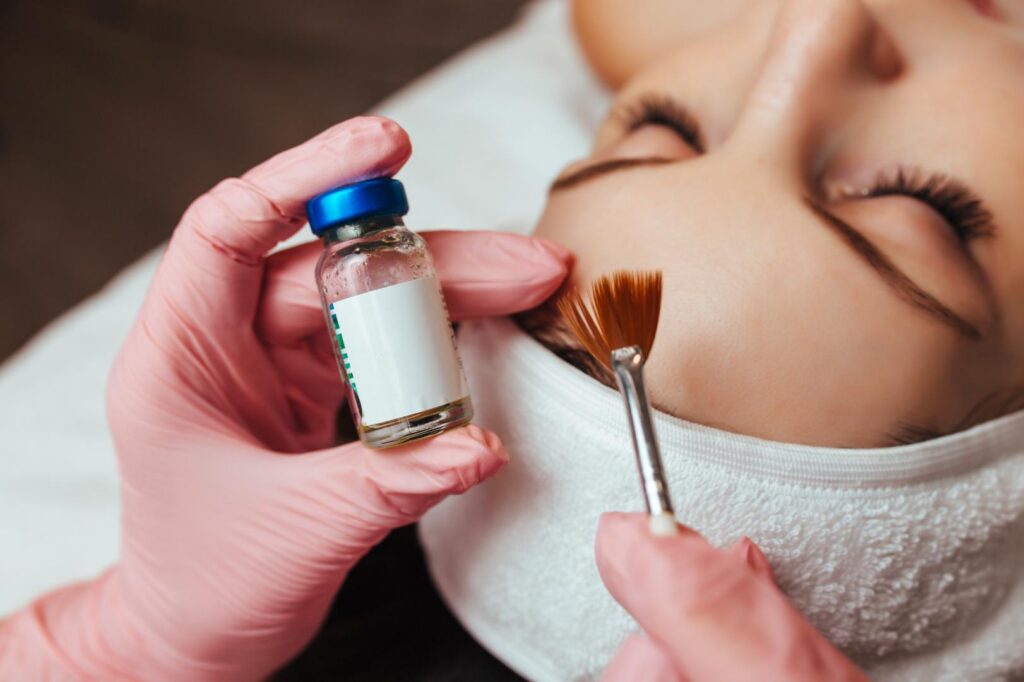
Chemical peels are another established dermatologic tool. They use carefully selected chemical solutions to create controlled exfoliation at varying depths. The AAD includes chemical peels among treatment options for depressed acne scars and notes that peel strength may range from mild to stronger formulations. Mild and medium treatments often require a series rather than a single session.
Chemical peels may be particularly useful when superficial discoloration, post-acne marks, and surface-level texture are part of the concern. However, a superficial peel shouldn’t be expected to perform the same job as RF microneedling or ablative resurfacing on deeper structural scars.
This is where matching the procedure to the concern becomes important again. If the skin is physically indented, collagen-remodeling procedures may have a larger role. If the main concern is flat discoloration, a pigment-focused approach may be more appropriate.
Sun protection is particularly important around peel treatment. The AAD recommends protecting the skin from the sun before a peel because doing so can help reduce the risk of post-treatment discoloration.
Where BioRePeel Fits
BioRePeel is one of the chemical peel services available at Fitzy Shades MedSpa. It can be discussed as part of the clinic’s exfoliation and skin-renewal options, but its claims should remain carefully framed.
Strong evidence exists for chemical peels as a treatment category in selected acne-scar and pigmentation plans. The AAD supports their use for certain depressed scars and explains that the effect of a peel depends partly on its strength.
However, evidence for the broader chemical-peel category shouldn’t automatically be presented as proof that a specific branded peel will correct deep scars or provide the same result as laser resurfacing or RF microneedling.
A safer, evidence-based way to think about BioRePeel is as one potential option when exfoliation, superficial texture, or post-acne discoloration are being addressed. Whether it belongs in your individual acne scars treatment plan depends on what your skin actually needs.
Control Breakouts Before Chasing Scars
If active inflammatory acne is still creating new lesions, treating existing scars without addressing the breakouts can become an endless cycle. The AAD recommends getting active acne under control before beginning many acne-scar treatments because reducing breakouts can lower inflammation and help prevent new scars from developing.
Picking and scratching also matter. The AAD explains that deeper cysts and nodules have a greater risk of scarring, and physically manipulating breakouts can further damage the skin. That means a treatment plan may happen in stages.
First, the priority may be limiting active acne. Once breakouts are more stable, attention can move toward persistent discoloration and structural scarring. This approach may feel slower, but it makes more sense than repeatedly correcting old damage while new scars continue forming.
Treat What Acne Actually Left Behind
Acne scars aren’t one single problem, and they shouldn’t be treated as one. Depressed scars, raised scars, dark acne marks, and uneven skin texture can each require a different strategy.
At Fitzy Shades MedSpa, patients looking for acne scar treatment in Prosper, TX, can explore SkinPen microneedling, Morpheus8 RF microneedling, ablative laser resurfacing, chemical peels, and BioRePeel.
The most useful approach starts with identifying what acne actually left behind and choosing treatment according to your skin rather than simply selecting the most aggressive procedure.
Call us today to book your consultation!